


Federal Constitutional Court becomes operational as two new judges sworn in
Pakistan
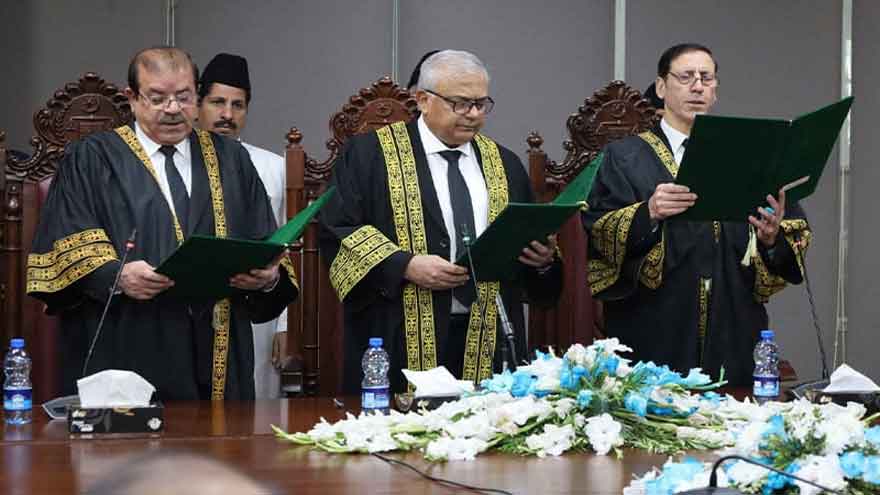
Two new judges, Justice Rozi Khan and Justice Arshad Hussain Shah, were sworn in at Pakistan's Federal Constitutional Court. Three benches were formed, and the court's shift to IHC building begins.

ISLAMABAD (Dunya News) – Two more judges were sworn in as member of the newly established Federal Constitutional Court on Monday.
Chief Justice of the Constitutional Court, Justice Aminuddin Khan, administered oath to Justice Rozi Khan and Justice Arshad Hussain Shah, taking total number of judges to seven.
The ceremony was attended by various judges, law officers, and judicial staff.
In addition to the swearing-in, Chief Justice Aminuddin Khan also announced the formation of three benches within the Federal Constitutional Court. The benches are as follows:
Bench 1: Chief Justice Aminuddin Khan, Justice Ali Baqir Najafi, and Justice Arshad Hussain
Bench 2: Justice Hassan Rizvi and Justice K.K. Agha
Bench 3: Justice Aamer Farooq and Justice Rozi Khan3
Read also: First decision of Federal Constitutional Court: stay granted on appeal by KP govt
The new benches will begin hearing cases immediately, contributing to the ongoing judicial workload of the court.
The shift of the Federal Constitutional Court into the Islamabad High Court building is underway. As part of the transition, Chief Justice of the Islamabad High Court, Justice Sarfraz Dogar, will continue to hear cases in Court 1, while Chief Justice of the Federal Constitutional Court, Justice Aminuddin Khan, will preside in Court 2.
Other judges, including Justice Mohsin Akhtar Kayani and Justice Mian Gul Oringzeb, have had their courts moved to different locations within the building.
Meanwhile, Pakistan’s first Federal Constitutional Court issued its first decision on Monday, suspending the Peshawar High Court’s ruling and granting a stay order on the appeal filed by the Khyber Pakhtunkhwa government.
A two-member bench, headed by Justice Hasan Rizvi, heard the Khyber Pakhtunkhwa government’s appeal, which requested suspension of the Peshawar High Court’s decision regarding employer–employee matters.
The Additional Advocate General informed the court that if a private institution does not pay the dues, the worker may file an appeal with the relevant department. If the decision is in favour of the worker, then the private institution must deposit the amount as security while filing an appeal.
