Summary Says diverse leadership can emerge only through smaller provinces
LAHORE (Dunya News) – Punjab Group Chairman Mian Amer Mahmood has said that public awareness has laid the foundation of democracy; small administrative units are essential for fair resource distribution
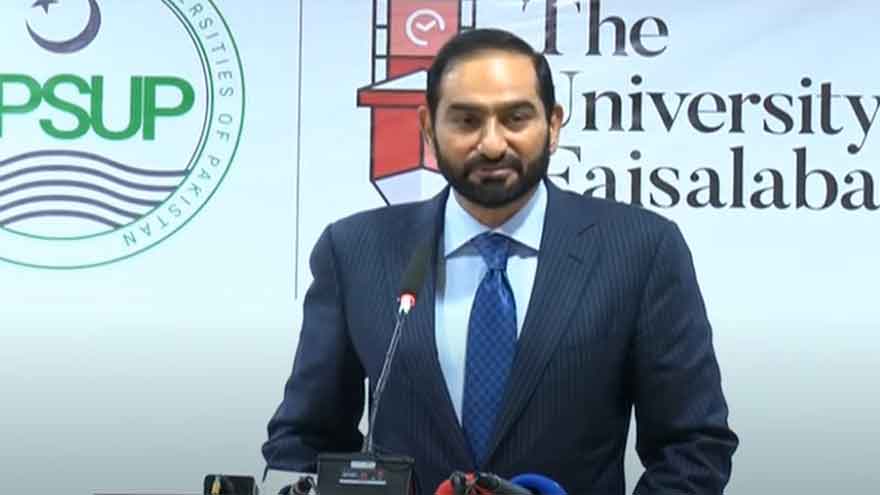
Addressing an awareness seminar organised by the private universities’ representative body “APSUP” at the University of Faisalabad, Punjab Group Chairman Mian Amer Mahmood said that 250 years ago, monarchies ruled, and kings collected wealth from the people to expand their empires.
When humanity took a turn, people became aware that the empire was growing at the cost of their own resources.
He added that the day people realised this, the foundation of democracy was laid. Democratic societies and nations emerged, and democratic countries sought to deliver resources to their citizens.
“To achieve this, it was realized that a national government was needed, along with smaller administrative units to ensure resources effectively reached the people,” he added.
“Local governments are responsible for solving administrative issues, yet for 78 years Pakistan has only spoken about establishing them. Even though the Constitution provides for local governments, provincial authorities refuse to devolve powers and resources, making the people the ultimate victims,” he said.
The Punjab Group chairman said that seven pillars form the foundation of any state: public welfare, social welfare, establishment of justice, and economic and political welfare among them. Public welfare, he said, is the foremost duty of every government, and we must honestly examine the state of our schools, hospitals, law and order, and justice system.
Referring to a World Bank report on Pakistan’s trajectory at 100 years, he warned that unless mistakes are corrected, the country will never reach its goals. He lamented the unequal rights across regions, saying justice is not delivered uniformly.
Highlighting imbalances, he noted Punjab makes up 53 percent of Pakistan’s population while the other three provinces together account for 43 percent.
“We are a federation where one unit is larger than the rest combined. Punjab, due to its population share, requires equal resources. Yet the other provinces don’t treat us fairly. Without devolution of powers, we cannot progress,” he said.
Read also: Mian Amer Mahmood advocates new provinces for fair resource allocation
Tracing history, he said West Pakistan was created with a population of 30 million, but today Pakistan’s population has risen to 250 million while still relying on only four provinces.
At independence, Balochistan had just 1.1 million people, and if issues had been addressed in time, today’s crises could have been avoided.
Mian Amer Mahmood pointed out that Pakistan now has 33 divisions and proposed Faisalabad as a separate province.
Leadership rises from middle class
“Globally, political leadership rises from the middle class. Unfortunately, our system does not allow this. If we had 33 provinces, leadership would be more diverse,” he said.
Citing India, he noted how a tea-seller, Narendra Modi, rose to become Prime Minister in 2014 by working for his home state of Gujarat, gaining corporate and popular support. “Similarly, when Arshad Nadeem won gold, the whole nation stood with him — but he first had to defeat the system before defeating his opponents in the field,” he added.
Turning to Pakistan’s justice system, he criticised the endless delays in civil and criminal litigation, with murder trials taking 16–18 years. “The fault lies not with judges, but with a broken system,” he stressed.
A Supreme Court judge handles 4,000 cases, with only four hours daily to hear 20–25 cases, while Lahore High Court judges face 3,000 cases each. “Such a system does not allow justice to be delivered,” he remarked.
Quoting surveys on public welfare, he said Pakistan ranks 140th on the Sustainable Development Index, 168th on the Human Development Index, and 109th out of 129 countries on the Global Hunger Index.
“Our religion says if even one person in 40 households sleeps hungry, we are responsible. Yet in Pakistan, people are going hungry, 44% of children are malnourished, nearly half of children lack food, and 25 million are out of school. We have destroyed our future 20 years ahead,” he warned.
Strong rule of law key to good governance
Mian Amer Mahmood said that if Pakistan seeks improvement, it must establish smaller administrative units. He stressed that the rule of law means ensuring justice, where no powerful person can usurp the rights of others.
“Law exists so that everyone has equal opportunities to move forward. We choose rulers so they can protect our rights, and the law ensures that no one can escape punishment for wrongdoing,” he said.
He added that corruption thrives when institutions are weak. Pakistan’s institutions, he noted, have grown too large to manage, yet the system below remains outdated.
“Good governance brings transparency. With smaller administrative units, people’s voices can be heard more effectively. Faisalabad, Pakistan’s third-largest city, has faced the greatest neglect,” he remarked.
Speaking about accountability, he said politicians do not fear NAB, courts, or jails, as they make up their losses once they return to power. “The biggest punishment for a politician is from the voter. If people stop voting for them, no greater penalty exists. Yet in Pakistan, only 2 to 4 leaders dominate, and their vote banks remain untouched,” he said.
Mian Amer Mahmood argued that more provinces would bring new leadership and improvement.
“Transparency is when a politician’s whole life is lived in front of the people. Once transparency takes root, politicians will naturally become better leaders,” he stated.
He emphasized that corruption is Pakistan’s greatest disease, describing the misuse of power for personal gain as its worst form.
“Corruption eats society like termites. The greatest accountability of a politician lies with the voter, and it is the voter’s duty to hold their leaders responsible,” he held.