


Europe confronts 'new nuclear reality' as Macron signals broader deterrence role
World
European leaders are increasingly confronting a once-taboo question: how to defend the continent in a more dangerous world if reliance on the United States can no longer be taken for granted.

PARIS (Agencies) - European leaders are increasingly confronting a once-taboo question: how to defend the continent in a more dangerous world if reliance on the United States can no longer be taken for granted.
With Russia’s war in Ukraine fuelling fears of a wider threat and uncertainty lingering over Washington’s long-term security commitments, the debate over nuclear deterrence has moved decisively into the political mainstream. Across Europe, governments are weighing how to strengthen their defences – and whether a more distinctly European nuclear role is now unavoidable.
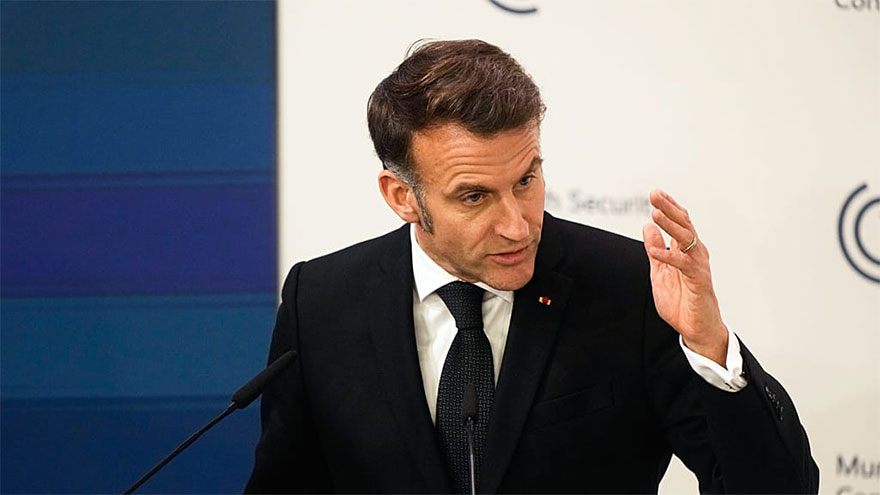
Against this shifting backdrop, French President Emmanuel Macron has stepped forward with a signal that Paris may be ready to lead. Speaking at the Munich Security Conference this weekend, he said he was considering a doctrine that could include “special cooperation, joint exercises, and shared security interests with certain key countries”.
The comments, ahead of a major speech on France’s nuclear strategy later this month, have raised expectations that France could expand its role as a nuclear guarantor for European partners.
Germany’s Chancellor Friedrich Merz has already held confidential talks with Macron on the issue, while British Prime Minister Keir Starmer said the UK is “enhancing our nuclear cooperation with France”. Britain and France remain Europe’s only nuclear-armed states, and both are now under growing pressure to adapt their deterrents to a changing security landscape.
A CONTINENT RETHINKS DETERRENCE
For decades, Europe’s defence has rested on NATO and, crucially, the US nuclear umbrella. That model is now being reassessed.
Russia’s increasingly assertive posture has convinced many European officials that its ambitions may not stop at Ukraine. At the same time, US President Donald Trump’s scepticism towards NATO and transactional approach to foreign policy have unsettled allies, raising doubts about whether American protection can be relied upon in all circumstances.
A report presented at the Munich Security Conference captures the mood starkly, warning that “the era in which Europe could afford strategic complacency has ended”. The authors argue that Europeans must stop outsourcing their nuclear thinking to the United States and instead confront a “new nuclear reality”.
The challenge, however, is formidable. The United States and Russia each possess thousands of nuclear warheads, while the combined British and French arsenals amount to only a few hundred. This gap makes it unrealistic for Europe to fully replace US deterrence in the near term.
Even so, the direction of travel is clear. Nuclear policy – long politically sensitive in many European countries – is now the subject of open and increasingly urgent debate.
DIFFICULT CHOICES AHEAD
The Munich report outlines five potential paths for Europe, while cautioning that none are straightforward or risk-free.
Maintaining reliance on US deterrence remains the most credible option in the short term. But other possibilities are gaining attention: strengthening the role of British and French nuclear forces, developing a joint European deterrent, allowing more countries to acquire nuclear weapons, or investing heavily in conventional military power as an alternative.
Each route comes with complications. Expanding French and British deterrence would raise sensitive questions about who ultimately controls nuclear weapons. The financial costs of building or scaling capabilities would also be significant.
There are practical constraints too. Britain’s nuclear system depends heavily on US technology, meaning there is currently “no sustainable future” for its deterrent without American cooperation, according to experts.
Despite this, there is a growing sense that Europe must act. Finnish Defence Minister Antti Hakkanen said increased investment in existing nuclear capabilities would be welcome, even if replacing the US role entirely is not realistic at present.
Analysts believe Macron’s forthcoming speech could prove a turning point. By setting out how France might extend its nuclear umbrella – even in a limited or cooperative way – he has the opportunity to give clearer direction to a debate that is rapidly gaining momentum.
