


Palestinians storm US-backed aid centres despite concerns over checks
World
Palestinians storm US-backed aid centres despite concerns over checks

CAIRO (Reuters) - Thousands of Palestinians on Tuesday stormed into sites where aid was being distributed by a foundation backed by the US and Israel, with desperation for food overcoming concern about biometric and other checks Israel said it would employ.
By late afternoon on Tuesday, the Gaza Humanitarian Foundation said it had distributed about 8,000 food boxes, equivalent to about 462,000 meals, after an almost three-month Israeli blockade of the war-devastated enclave.
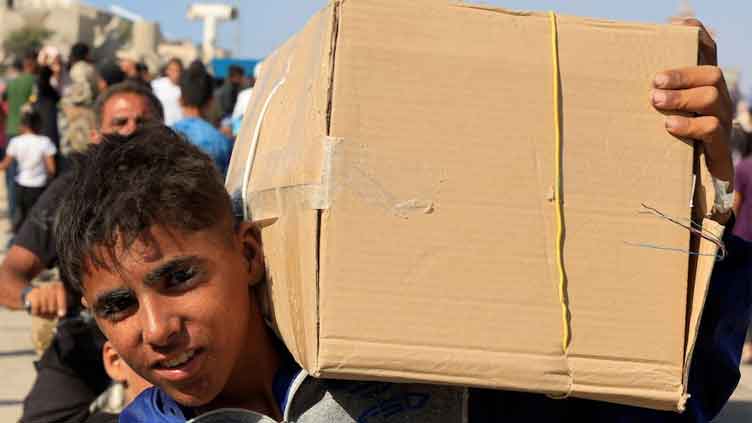
In the southern city of Rafah, which is under full Israeli army control, thousands of people including women and children, some on foot or in donkey carts, flocked towards one of the distribution sites to receive food packages.
Footage, some of which Reuters could not immediately verify, showed lines of people walking through a wired-off corridor and into a large open field where aid was stacked. Later, images shared on social media showed large parts of the fence torn down as people jostled their way onto the site.
Israel and the Gaza Humanitarian Foundation said, without providing evidence, that Hamas had tried to block civilians from reaching the aid distribution centre.
Hamas denied the accusation.
"The real cause of the delay and collapse in the aid distribution process is the tragic chaos caused by the mismanagement of the same company operating under the Israeli occupation’s administration in those buffer zones," Ismail Al-Thawabta, director of the Hamas-run Gaza government media office, told Reuters.
"This has led to thousands of starving people, under the pressure of siege and hunger, storming distribution centres and seizing food, during which Israeli forces opened fire," he added.
Israeli foreign ministry spokesperson Oren Marmorstein wrote on X that 8,000 "food packages" were delivered to Palestinians on Tuesday, the first day of what he described as an American initiative.
Some of the recipients showed the content of the packages, which included some rice, flour, canned beans, pasta, olive oil, biscuits and sugar.
SCREENING PROCEDURES
Although the aid was available on Monday, Palestinians appeared to have heeded warnings, including from Hamas, about biometric screening procedures employed at the foundation's aid distribution sites.
"As much as I want to go because I am hungry and my children are hungry, I am afraid," said Abu Ahmed, 55, a father of seven. "I am so scared because they said the company belongs to Israel and is a mercenary, and also because the resistance (Hamas) said not to go," he said in a message on the chat app WhatsApp.
Israel says the Switzerland-based GHF is a US-backed initiative and that its forces will not be involved in the distribution points where food will be handed out.
But its endorsement of the plan, which resembles Israeli schemes floated previously, and its closeness with the US has led many to question the neutrality of the foundation, including its own former chief, who resigned unexpectedly on Sunday.
The Israeli military said four aid sites have been established in recent weeks across the enclave, and that two of them in the area of Rafah began operations on Tuesday and "are distributing food packages to thousands of families in the Gaza Strip."
The GHF said the volume of people seeking aid at one distribution site was so great at one point on Tuesday that its team had to pull back to allow people to "take aid safely and dissipate" and to avoid casualties. It said normal operations had since resumed.
Israeli officials said one of the advantages of the new aid system is the opportunity to screen recipients to exclude anyone found to be connected with Hamas.
Humanitarian groups briefed on the foundation's plans say anyone accessing aid will have to submit to facial recognition technology that many Palestinians fear will end up in Israeli hands to be used to track and potentially target them.
Details of exactly how the system will operate have not been made public.
