


Faisalabad tops Pakistan's air pollution chart as smog worsens across Punjab
Pakistan
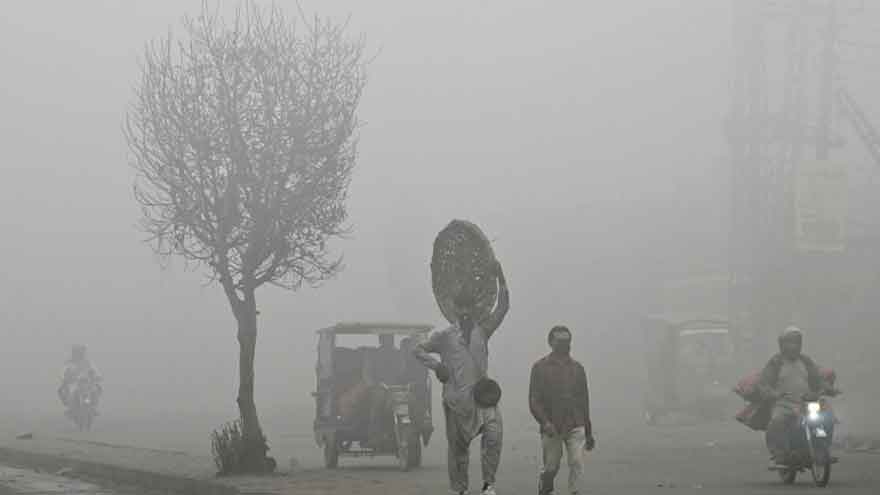
Faisalabad leads Punjab in dangerous air pollution levels as smog thickens across the province, with Lahore, Gujranwala, and Multan also facing severely unhealthy air quality.

LAHORE (Dunya News) - The air pollution and smog situation in Punjab continues to deteriorate, with Faisalabad ranking as the most polluted city in the province today.
According to data from the global air quality monitoring organization IQAir, Faisalabad currently tops the list for air pollution, followed by Gujranwala and Multan. Lahore recorded an Air Quality Index (AQI) of 471 this morning.
IQAir reported AQI levels of 554 in Faisalabad, 546 in Gujranwala, 478 in Multan, 471 in Lahore, and 389 in Bahawalpur. However, official statistics showed slightly different figures, with D.G. Khan, Gujranwala, and Kasur recording 500, Lahore 447, Faisalabad 408, and Multan 352 AQI in the morning hours.
In Lahore, pollution has reached hazardous levels in several areas — the Forest Department Office on Ravi Road recorded 980, G3 Engineering Council 790, and DHA Phase 8 measured 759 AQI. Meanwhile, Punjab’s official Air Quality Index recorded at Barqi Road and Egerton Road at 500, Wahga Border at 394, and Safari Park at 384.
According to the Smog Monitoring and Forecasting System, wind flow in Punjab is currently moving from east to west. The Environmental Protection Department (EPD) stated that polluted winds from India’s Haryana, Ludhiana, Patiala, and Jalandhar regions are entering Pakistan, impacting the air quality in Lahore, Faisalabad, Kasur, and Gujranwala.
Experts warn that smog and the accumulation of fine particulate matter are worsening air pollution, with AQI levels expected to remain between 330 and 370 today.
The Environment Department has predicted that Lahore’s air quality will remain unhealthy, with higher pollution levels expected in the early morning, late evening, and nighttime hours. Slight improvement may occur between 1 p.m. and 5 p.m., but overall conditions will stay unhealthy.
Citizens, especially children, the elderly, and patients, are advised to avoid unnecessary outdoor activities.
