


At UNGA, PM Shehbaz warns India over Indus waters; calls Gaza tragedy 'heart-wrenching'
Pakistan
Pakistani premier pushes dialogue for South Asia peace despite defeating India earlier this year
Pakistan vows to defend Kashmiris' right to self-determination
Israel's Gaza assault called 'one of darkest chapters in history'
Shehbaz Sharif backs Nobel Peace Prize nomination for Trump

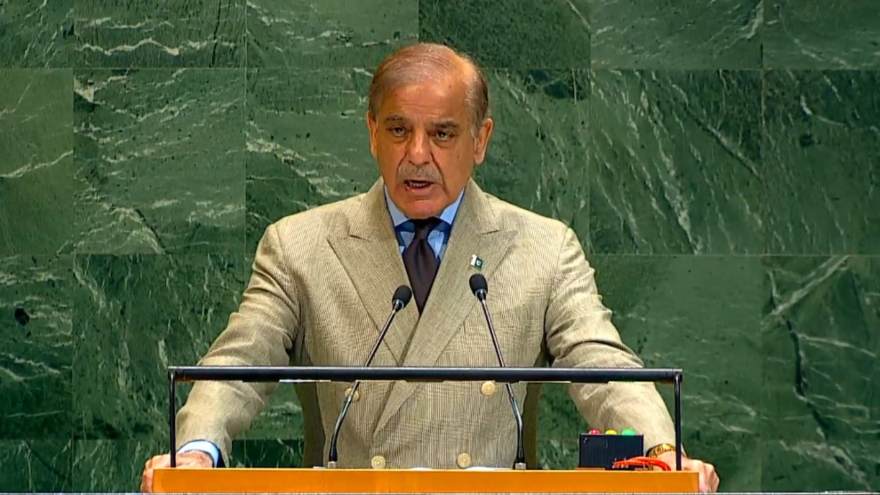
NEW YORK (Dunya News) – Prime Minister Shehbaz Sharif is addressing the 80th session of the United Nations General Assembly in New York, presenting Pakistan’s stance on global and regional challenges.
At the outset of his address, the Prime Minister remarked that the world today was more complex than ever, with conflicts intensifying, international law being brazenly violated, humanitarian crises multiplying, terrorism persisting as a potent threat, disinformation undermining trust, and climate change threatening survival – particularly for vulnerable nations like Pakistan.
“Our world is more complex today than ever before. Conflicts are intensifying, international law is being brazenly violated, humanitarian crises are multiplying, terrorism remains a potent threat, disinformation and fake news undermine trust, climate change threatens our very survival, and more so for countries like Pakistan,” he said.
براہِ راست: وزیراعظم محمد شہباز شریف کا اقوام متحدہ جنرل اسمبلی کے 80 ویں اجلاس سے خطاب https://t.co/NqwuQeuG8g
— Government of Pakistan (@GovtofPakistan) September 26, 2025
Call for multilateralism
“Today, multilateralism is no longer an option; it is a need of the hour. Pakistan's foreign policy, guided by Quaid-i-Azam, is based on peace, mutual respect, and cooperation. We believe in the peaceful settlement of disputes through dialogue and diplomacy,” the Prime Minister stated.
He recalled his remarks from last year’s UNGA session: “Last year, from this very podium, I had warned that Pakistan would act and act most decisively against any external aggression. Those words of mine prove true. I hoped [they would not]. But then that is destiny. In May this year, my country confronted unresolved aggression from our eastern front. The enemy came shrouded in arrogance; we sent them back in humiliation, delivering a bloody nose.”
India-Pakistan escalation
Shehbaz Sharif accused India of politicising tragedy, saying: “India sought to extract political gains from a human tragedy by spurning my sincere offer of an independent international investigation into the Pahalgam incident. Instead, it attacked our cities and targeted our innocent citizens. When our territorial integrity and national security were violated, our response was in accordance with the right of self-defence under Article 51 of the UN Charter.”
Praising Pakistan’s military response, he continued: “Our valiant armed forces under the leadership of Field Marshal Asim Munir mounted an operation of stunning professionalism and bravery, repulsing the enemy’s attack under the air chief marshal. Our falcons took flight and etched their answer across the skies and resulting in seven of the Indian jets turn to scrap and dust, a decisive response. A decisive response to the aggressor that will echo through the annals of history.”
He paid tribute to the armed forces and the public, declaring: “To the fairness architect of this victory, to every officer and soldier, heirs of our martyrs, their names are forever engraved in glory. The mothers of our martyrs, their courage guides our path forward and their sacrifice shall never be in vain, God willing. And to every Pakistani, you stood as one unbreakable wall – Bunyanum Marsoos.”
Ceasefire and diplomacy
The prime minister noted that Pakistan had agreed to a ceasefire after four days of escalation with India in May, from what he called “a position of strength.” He also expressed gratitude to US President Donald Trump and his team for their role in mediating peace.
“President Trump’s efforts for peace helped avert a … war in South Asia. Had he not intervened timely and decisively, the consequences of a full-fledged war would have been catastrophic,” Shehbaz said. “Therefore, in recognition of President Trump’s wonderful and outstanding contribution to promote peace in our part of the world, Pakistan nominated him for the Nobel Peace Prize. This is the least we could do … I think he truly is a man of peace.”
PM Shehbaz, Field Marshal Asim Munir hail Trump as peace ambassador
He further thanked Pakistan’s partners, including China, Turkiye, Saudi Arabia, Qatar, Azerbaijan, Iran, the United Arab Emirates, and the UN Secretary-General for their diplomatic support during the confrontation.
Concluding this part of his address, Shehbaz Sharif told the assembly: “We have won the war, and now we seek to win peace in our part of the world. This is my most sincere serious offer before this august assembly of the world nations. Pakistan stands ready for a composite, comprehensive and result-oriented dialogue with India on all outstanding issues.”
Indus Waters Treaty
Turning to another critical issue, the prime minister emphasised the need for responsible leadership in South Asia. “South Asia requires proactive rather than provocative leadership. India’s unilateral and illegal attempt to hold the Indus Water Treaty in abeyance defies the provisions of the treaty itself as well as the norms of international law.”
He added: “Pakistan has made it abundantly clear and led there be no doubt once again in anybody's mind, as I said last year in this hall from this podium, we will definitely and ardently defend the inseparable right of our 240 million people on these waters. To us, any violation of this IWT represents an act of war.”
Pakistan stands with Kashmiris
“Through this house, I wish to assure the Kashmiris that I stand with them, the people of Pakistan stand with them, and one day soon India’s tyranny in Kashmir will come to a grinding halt, Kashmir will gain its fundamental right to self-determination through an impartial plebiscite under the auspices of this very organisation, the UN.”
Gaza conflict
Turning his attention to Gaza, the prime minister said the plight of the Palestinian people was one of the “most heart-wrenching tragedies of our time.”
“This prolonged injustice is a stain on the global conscience and our collective moral failure,” he remarked. “For nearly 80 years, the Palestinians have courageously endured Israel’s brutal occupation of their homeland. In the West Bank, each passing day brings new brutality.”
In Gaza, he said, Israel’s genocidal onslaught had unleashed unspeakable terror upon women and children in a manner unprecedented in history.
“In the blind pursuit of its nefarious goals, the Israeli leadership has unleashed a shameful campaign against innocent Palestinians, which history will remember as one of its darkest chapters,” he added.
Emphasising the need to raise a united voice against atrocities in Gaza, he said: “We must speak, and speak loud and clear.”
He continued: “Our words are too little and too late for Hind Rajab. A child, nay a little baby… My agony, the agony of the entire Muslim ummah, and the agony of nations across the planet, is that we failed Hind Rajab. And she will not forgive us.
“The smallest coffins are the heaviest to carry. I know this pain, as I carried the coffin of Irtaza Abbas during the recent confrontation with India. He was only six years old. Therefore, we cannot and must not fail the children of Gaza, or any child anywhere in the world. We must find a path to a ceasefire now.”
He reaffirmed Pakistan’s support for a sovereign Palestinian state with pre-1967 borders and Jerusalem as its capital.
“Palestine can no longer remain under Israeli shackles. It must be liberated, and liberated with full commitment and full force,” he stressed.
He also welcomed the recent recognition of Palestine by several countries and urged others to follow suit.
Referring to a meeting of Donald Trump with leaders of some Muslim countries earlier this week, he appreciated the US president’s “timely initiative” to convene a moot on Gaza.
“I was also part of that consultative process, and I hope and pray to God that it rekindles hope for a ceasefire in the near future,” PM Shehbaz said.
He also condemned Israel’s recent attack on Doha targeting Hamas leaders and expressed solidarity with Qatar.
The premier further expressed support for efforts to peacefully resolve the Ukraine conflict in line with the UN Charter, “to end human suffering and global turmoil caused by this protracted war.”
