Summary Underscores need to spread public awareness on creating new provinces
LAHORE (Dunya News) – Punjab Group Chairman Mian Amer Mahmood has stressed the need for creating new provinces in Pakistan to ensure fair distribution of resources, equal rights, and effective governance, warning that mismanagement and unequal access to resources hinder national progress.
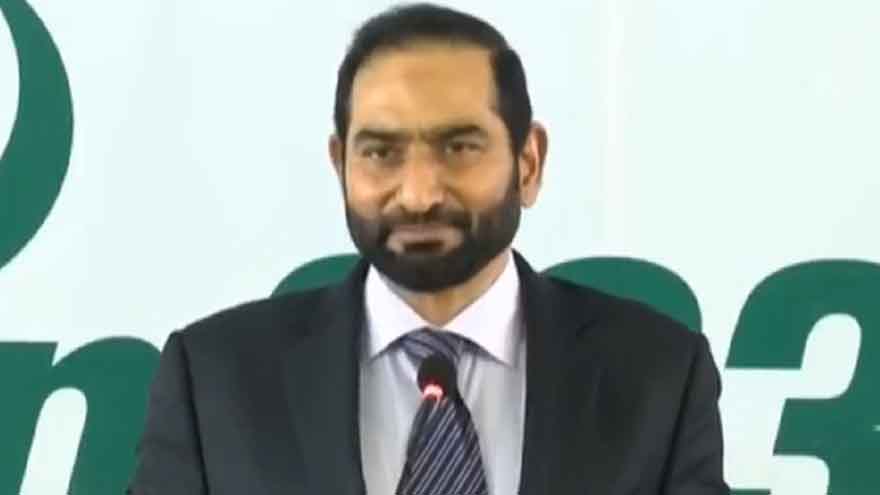
Speaking at a seminar titled “Pakistan 2030: Challenges, Opportunities, and New Pathways” organized by private universities under “SupApp” at Punjab University’s Institute of Business Administration, Mian Amer Mahmood said that in the past, wealth and kingdoms were the privilege of monarchs. About 250 years ago, various empires and monarchies were established across the world, and territories were expanded through conquests. However, with time, countries began to emerge that were driven by the power of their people.
Mian Amer Mahmood, in his address, said that IBA is his own institute, where he studied and even served as a student leader. He added that public awareness and people’s power are the foundations that have completely transformed global political and social systems.
The Punjab Group chairman said that, over time, nations emerged that were driven by the strength of their people. “Citizens love their country because their rights are recognised and protected there,” he added.
He further said that today, in various political science books, we study the principles on which a state is founded, including seven key elements. Nations decided to deliver welfare to the people and divide administrative units, which led to the establishment of provincial governments.
Recalling history, Mian Amer Mahmood noted that at the time of East Pakistan’s creation, its population was about 30 million and it had four provinces. In contrast, Punjab’s population has now grown from 20 million to nearly 130 million.
Speaking on the deprivations of Balochistan, he said that although natural gas is extracted from there, its own people are still deprived of its supply. He stressed that for a strong and sustainable state, ensuring people’s rights, equality, and fair distribution of resources is essential.
Mian Amer Mahmood said that Pakistan ranks among the lowest in human development and welfare indicators, which is an alarming situation. He pointed out that in the Human Development Index, Pakistan stands at 168 out of 193 countries — ahead only of nations suffering from continuous civil wars.
The Punjab Group Chairman stressed that no civilized or developed country ranks below Pakistan, which is a matter of deep concern. He added that in terms of Sustainable Development Goals (SDGs), Pakistan is placed at 140, a position that is by no means admirable.
He questioned what kind of opportunities Pakistan is providing its people for progress and a better future. “For me, the Human Development Index is the most important benchmark, as it determines how many facilities and opportunities a country gives to its citizens,” he said.
Mian Amer Mahmood underlined that this is not about theories but about hard facts. “Developed and welfare states are moving forward by providing education, healthcare, and employment opportunities to their people, while Pakistan has lagged far behind,” he remarked.
Pakistan ranks extremely low in global indicators
The Punjab Group chairman noted that Pakistan ranks extremely low in global indicators related to human development, rule of law, and hunger. He said that in a global rule of law survey, Pakistan stands at 129th out of 142 countries, while in the Global Hunger Index, Pakistan is ranked 109th out of 129. “Our people are still going to bed hungry. It is the fundamental duty of the government and local administration to ensure that no one sleeps hungry,” he stressed.
He added that if even one person in a neighborhood of 40 households sleeps without food, the responsibility falls on everyone. “The question is: what opportunities are we giving our people to move forward?” he asked.
Mian Amer Mahmood further said that Pakistan’s situation in hunger, education, and employment is highly concerning. “If we do not wake up now, the future will become even more dangerous,” he warned.
25 million out-of-school children
Highlighting the education crisis, he said that 44% of children in Pakistan suffer from stunted growth, while nearly half do not get enough food. Around 25 million children are currently out of school, making Pakistan the only country in the world with such a large number of children deprived of education.
He added that 64% of Pakistan’s population comprises youth, but a significant portion of them are unable to secure jobs. “What will you do with so many unemployed young people? We must think about what kind of society we are heading towards,” he cautioned.
Making a division into a province will reduce expenses
Punjab Group Chairman Mian Amer Mahmood said that Lahore is a division which includes Kasur and Sheikhupura. “A division is made up of districts. What we are suggesting is to make the commissioner of that division the chief secretary, and the RPO the IG,” he explained.
He added that the common objection is that if divisions are made into provinces, there would be 33 provinces in total, and the question arises: where will resources come from for 33 provinces? “We have researched this, and if every division is made into a province, expenses will actually decrease, not increase. When a province’s population reduces from 130 million to 30 million, administrative costs also go down,” he argued.
New provinces will have elected setups
Mian Amer Mahmood said that in all the global indices he mentioned earlier, Pakistan ranks at the bottom. “We are last in education, hunger is rampant, children are growing up stunted. We do not lack resources, especially not at the provincial level.
"New provinces will have their own elected setups,” he stressed.
He further said that Pakistan has not been able to get leadership focused on public welfare for decades. “In such a huge system, it seems almost impossible for genuine leadership to emerge. A few families have the potential to produce leaders, and the establishment also has the resources to promote someone,” he remarked.
System does not support the common man
The Punjab Group chairman said that there is no system of organic growth of leadership in Pakistan. “In such a vast structure, perhaps it is not even possible. An ordinary person cannot progress beyond a certain point in politics. The system simply does not support the common man,” he said.
Referring to javelin thrower Arshad Nadeem, he added: “He won the gold medal because he first defeated the system.”
He said that the state of the high courts and district courts speaks for itself — each judge is burdened with hundreds of cases, making it impossible for them to give full attention to any single case. “In this country, civil and litigation cases never seem to end. Anyone who gets caught up in the courts sees their life destroyed. In murder cases, it takes 16 to 18 years for a verdict, and during that time both the victim’s and the killer’s families are ruined,” he noted.
Smaller provinces will improve budget balance
He said that if a commissioner is made the chief secretary and an RPO is appointed as the IG, the supervisory structure will be significantly reduced, leading to lower government expenses. “All the extra supervisory layers at the top would be eliminated, which would cut costs,” he explained.
Comparing the expenses of Punjab and Balochistan, Mian Amer Mahmood noted that the operating costs of the Chief Minister’s House and Secretariat in both provinces are vastly different. Since Balochistan’s budget and population are smaller than Punjab’s, its expenditures are also much lower.
He added that creating smaller provinces would not only distribute the burden of population and bureaucracy but also help balance the budget. “With smaller provinces, expenses will decrease and the development budget may actually increase,” he said.
With leadership, everything will improve
Mian Amer Mahmood said that no provincial government is willing to devolve its powers to the grassroots level. “We have spent 78 years in this cycle of having local government one day and abolishing it the next. There will surely be at least one chief minister who will run local government effectively in his province. If there is leadership, everything will get better,” he emphasized.
He added that Pakistan lacks any organic system of leadership growth. “If there are 33 provinces, at least a few chief ministers will emerge who perform well. Such leaders will eventually rise to the national level. People will say: the chief minister of Sargodha, Rawalpindi, or Karachi did an excellent job,” he explained.
The Punjab Group chairman cited India as an example, saying: “There, even a tea seller became a chief minister. He worked for his province, and Narendra Modi grew as a leader because of his performance in Gujarat. When Modi launched his campaign, all of corporate India stood behind him. BJP became a majority party and didn’t need coalition partners. Leaders like L.K. Advani disappeared from the scene.”
Without the establishment’s backing, Imran’s struggle would have lasted 44 years
He said that leadership opportunities arise where people can choose leaders, but such chances are missing in Pakistan. “Some families dominate politics. Our last prime minister was made with the establishment’s support. The PTI founder used to say he had struggled for 22 years. I told him his struggle would have stretched to 44 years had the establishment not stood behind him,” Mian Amer Mahmood revealed.
He regretted that this is how the system works, but insisted that the creation of new provinces could solve many problems. “Today, managing such a massive population has become difficult for the government. When governance is closer to the people, problems will be seen more directly and resolved more effectively,” he argued.
The Punjab Group chairman further said that provinces currently have no shortage of resources. “They have so much money that they don’t even know where to spend it. Just look at the provincial budgets. Despite all these funds, problems remain unresolved — which means the real issue lies elsewhere,” he pointed out.
Not a single multinational pharmaceutical company in Pakistan
Punjab Group Chairman Mian Amer Mahmood said that Pakistan does not have even a single multinational pharmaceutical company. “Who would want to come here when people are leaving instead? Pakistan’s population is 64% youth, yet less than one percent of them make it to universities,” he noted.
He added, “We are not here with an election agenda. We are here to talk about the youth. I want to bring awareness among Pakistan’s youth and people. You are the one percent who made it to colleges and universities, and with that privilege comes responsibility. When policies start emerging from educational institutions, the country will succeed. The youth must carry this message forward.”
If Balochistan had five provinces, separatist movements wouldn’t exist
Mian Amer Mahmood said that just as Pakistanis love their country, the people of Sindh and Khyber Pakhtunkhwa also hold their homeland dear. “We are explaining the benefits and drawbacks of creating new provinces. Everyone wants a better future for themselves and their children. Our campaign has no personal gain — this is only the first step,” he said.
He argued that today there is a separatist movement in Balochistan, but if Balochistan had five provinces, such a movement would not exist. Referring to India, he said: “There was a Khalistan movement in Indian Punjab. India divided Punjab into three provinces, and today there is no Khalistan movement there. It only exists in England and Canada, not in India.”
Provinces are unwilling to devolve power
The Punjab Group Chairman noted that Pakistan’s provinces are not ready to transfer powers to the grassroots level. “When you have 33 provinces, at least six chief ministers will empower local governments,” he said.
He added that since 2002, every assembly in Pakistan has completed its full five-year term. Prime ministers may have changed, but assemblies continued. “The only way to capture political leadership’s attention is through public opinion, and we are working to raise awareness among the people,” he emphasized.
Political leadership must rise through people’s votes
Mian Amer Mahmood said that the people of Pakistan are suffering injustice. “Our children are dying of hunger, growth is stunted. Political leadership must run on our emotions and be elected through our votes,” he said.
He added that when a province grows larger than many countries, disintegration becomes a risk. “Where there is economic growth, there is no breakup. If provinces are created, leadership will emerge and problems will be resolved. The purpose of local government is to provide municipal services,” he explained.
No system for leadership growth
He pointed out that Pakistan’s politics is dominated by a handful of parties because there is no mechanism for nurturing new leadership. “If there are 33 provinces, no one will have 33 sons or brothers to occupy chief minister posts. Political workers will have to be promoted, and that is how leadership growth will occur,” he remarked.
He further said that under the NFC Award, resources are distributed automatically. “No government can change the NFC; it is constitutionally protected. Whatever resources Pakistan gets are divided among provinces under this system. The issue lies in governance, not resources,” he stated.
PTI founder is not the first leader to go to jail
Mian Amer Mahmood reminded that Imran Khan is not the first political leader imprisoned. “Shaheed Zulfikar Ali Bhutto was immensely popular but was executed. Nawaz Sharif came into power with a two-thirds majority and governments in all four provinces, but he was ousted and exiled,” he said.
He asked why Pakistani politicians face such repeated setbacks. “Being popular is not enough. Even Tayyip Erdogan faced a coup attempt in Turkiye, but the people came out in his support and defeated it. Plans made against him failed because of people’s power. Unfortunately, this does not happen here,” he lamented.
Our political leadership never grew organically
He said that if there is a case in the Supreme Court involving a party founder and 100,000 people gather outside, can anyone believe the verdict won’t be influenced? “Political leadership must reflect on this. The truth is, our political leaders have never gone through an organic growth process — they come through other doors. That’s why they fail to deliver,” he argued.
Mian Amer Mahmood added that people do not come out for politicians because those politicians have done nothing for them. “In a political, democratic system, the greatest safeguard is the people themselves. If citizens are unwilling to defend this system, then clearly there is a deeper problem,” he concluded.
Earlier, on August 20 at Superior University and on August 28 at the University of Lahore, Mian Amer Mahmood had also proposed the creation of new provinces in Pakistan during his special addresses.