Summary 'We expect Pakistan’s inflation to average between 6–7 percent this year'
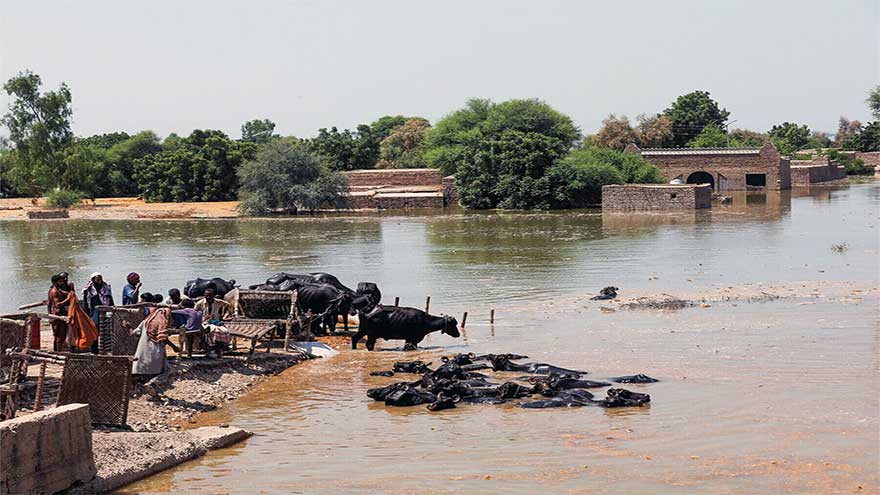
KARACHI (Web Desk) - Devastating floods in Pakistan’s eastern Punjab province may cause inflation to surge in the coming days, financial experts and animal traders warned this week, with the deluges killing thousands of livestock, triggering supply disruptions.
Pakistan is an agrarian economy and has a total number of livestock amounting to 251.3 million. This includes 56 million cows, 48 million buffalos, 45 million sheep, 96 million goats, 1.5 million camels and 4.8 million asses, according to the Pakistan Bureau of Statistics’ latest agriculture census.
The country’s richest, breadbasket province of Punjab has been reeling from floods since late August. Heavy monsoon rains and excess waters released by India have caused rivers in the province to swell, killing at least 56 and inundating over 4,000 villages. Since Jun. 26, floods have killed more than 6,180 livestock, according to the National Disaster Management Authority (NDMA).
In Punjab, while only 121 livestock have perished since Jun. 26, rescue teams have evacuated over 1.5 million livestock since late August to Sept. 7, according to data provided by the Provincial Disaster Management Authority (PDMA) Director General Irfan Ali Kathia. The damage to livestock has disrupted the supply chain, threatened to diminish meat exports and caused food prices to push up.
“The recent floods may push up food inflation and overall inflation in the months to come amidst expected damages to crops and the supply chain,” Shankar Talreja, head of research at brokerage firm Topline Securities, told a newspaper. “These floods are likely to create an additional 100 basis points impact on inflation.”
Pakistan’s government has been trying to keep inflation in check and was able to slash it to a record 0.3 percent in April from 38 percent in May 2023. The central bank has also halved its key interest rate to 11 percent since May 2024.
“We expect Pakistan’s inflation to average between 6–7 percent this year,” Talreja said, referring to the impact caused by losses inflicted by floods on both crops and livestock. “The impact of floods is likely to keep food prices under pressure.”
Today, wheat prices have already climbed to Rs4,000 per 40 kilograms, the highest in two years, while the weekly inflation index has surged to a 35-week high.
However, Sana Tawfik, an economist and head of research at Karachi-based brokerage firm Arif Habib, said the NDMA’s reported losses remain far below the scale of destruction of the 2022 floods.
Those floods had killed over 1,700 people and nearly 1.2 million animals.
“The average value of these 6,000 plus animals perished can be roughly estimated at about Rs500 million ($177,525),” she said, adding that so far, no major impact on the gross domestic product had been observed.
She said “clearer data” about the damage to livestock would emerge in the weeks to come.
“This is not a significant percentage of our GDP now, but it can rise if floods cause more damage in the days ahead,” Tawfik warned.
“The contribution of livestock to GDP is about 13–14 percent, which is substantial. If the number of animal deaths increases, the impact on the economy will be much larger.”
PUNJAB CATTLE HUBS ‘CUT OFF’
For Karachi-based beef trader Sher Alam, the impact of recent floods has already begun to bite. Selling as much as 250 kilograms of beef daily, he says the shortage of animals is driving up prices at an alarming pace of 14 percent.
“The prices of animals have started rising because of the livestock shortage these floods are creating,” Alam told a News.
“For example, today I bought a bull weighing 90 kilograms for Rs125,000 ($444). Before the floods, such animals cost Rs110,000 ($390),” he added.
Alam usually travels to cattle markets in Punjab’s Bahawalpur and Multan districts to buy livestock. These routes now remain blocked due to the floods.
“We are forced to buy from Karachi’s buffalo colony instead,” he lamented. “With many roads under water, our access to Punjab’s major cattle hubs is cut off.”
And the effects are evident. Trailer truck operators, who charged Rs150,000 ($533) to transport around 35 animals, are now demanding up to Rs400,000 ($1,775) per trip. Fodder shortages in flood-affected districts have further intensified the crisis, as farmers struggle to save their herds.