Summary In his letter, Pezeshkian stated that Iran has not initiated wars against other nations, saying: “Since the inception of the US, and even before that, Iran hasn’t initiated a war against any country"
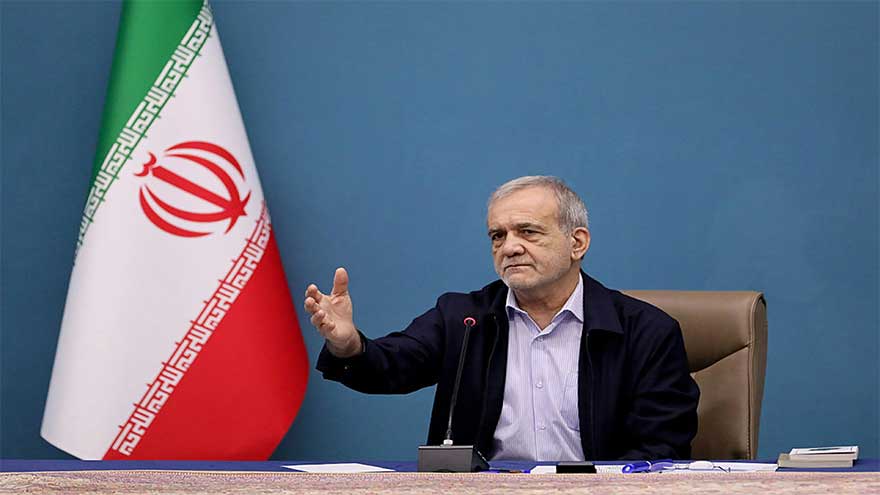
(Web Desk) — Iranian President Masoud Pezeshkian has said that Iran is not an aggressive country and is instead acting in self-defence amid rising regional tensions.
According to Al Jazeera, President Pezeshkian addressed an open letter directly to the American public — rather than US leadership — arguing that Tehran is responding to what he described as a US-backed proxy conflict involving Israel.
In his letter, Pezeshkian stated that Iran has not initiated wars against other nations, saying: “Since the inception of the United States, and even before that, Iran hasn’t initiated a war against any foreign country.”
He added that portraying Iran as a regional threat is a narrative used to justify aggression.
The Iranian president also claimed that the United States is effectively “waging a proxy war on behalf of Israel,” while asserting Iran’s right to develop defensive capabilities. “What we do in response is based on the legitimate right of self-defence, not an act of aggression,” he said.
Pezeshkian urged Americans to look beyond political rhetoric and reassess their government’s policies toward Iran. Questioning US priorities, he asked: “Is ‘America First’ truly among the priorities of the US government today?”
He also highlighted the contributions of Iranian citizens and diaspora communities, encouraging Americans to judge Iran based on real-world interactions rather than what he described as misinformation.
“The world stands at a crossroads,” Pezeshkian wrote, warning that continued hostility toward Iran would be “costlier and more futile than ever before.” He described the choice between confrontation and engagement as one that would shape future generations.
Pezeshkian said that Iran’s current distrust of Washington is due to several reasons, including foreign intervention and “inhumane sanctions”.
“Relations between Iran and the United States were not originally hostile, and early interactions between the Iranian and American people were not marred with hostility or tension,” he said.
However, Pezeshkian noted that the “turning point” was the 1953 coup d’etat, describing it as “an illegal American intervention aimed at preventing the nationalisation of Iran’s own resources”.
He said the distrust “deepened further” through support for former leader Reza Shah Pehlavi’s rule, backing of Iraqi leader Saddam Hussein, sweeping, sanctions and “unprovoked military aggression – twice, in the midst of negotiations, against Iran”.
“The continuation of military aggression and recent bombings profoundly affect people’s lives, attitudes, and perspectives,” Iran’s president said.
FOREIGN MINISTRY CONFIRMS INDIRECT MESSAGES
Iran’s Foreign Ministry spokesperson confirmed that Tehran has received messages through intermediaries and is currently reviewing them. The spokesperson emphasized that Iran remains prepared to respond to any form of aggression.
Meanwhile, Iran’s Foreign Minister Abbas Araghchi told Al Jazeera earlier this week that although messages had been exchanged with US envoy Steve Witkoff, “this does not mean that we are in negotiations.”
IRAQI ARMED GROUPS CLAIM ATTACKS ON US BASES
In a separate development, an Iraqi armed group, Saraya Awliya al-Dam, claimed responsibility for multiple attacks on US military installations in the region.
In a statement posted on Telegram, the group said it carried out six strikes within 24 hours, including attacks targeting US positions in Erbil. However, no independent verification of these claims has been reported.
Another group, the Islamic Resistance in Iraq, also claimed responsibility for a broader campaign, stating it had conducted 41 operations against US bases in Iraq and surrounding areas, including drone attacks.