Summary Lawmakers voted 218-213 to approve the SAVE America Act, with only one Democrat joining Republicans to back the measure
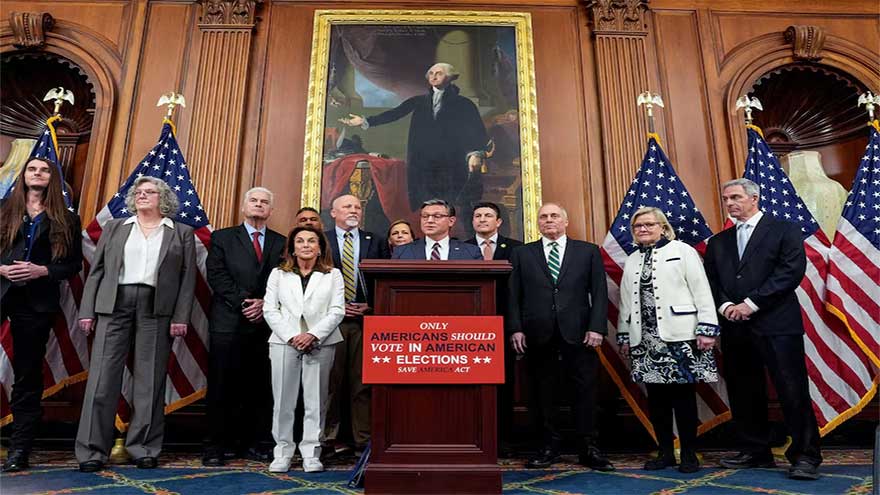
WASHINGTON (Reuters) – The Republican-controlled House of Representatives voted on Wednesday to require proof of US citizenship in the November midterm elections, which Democrats said would impose unnecessary burdens on American voters and concentrate electoral power in the hands of President Donald Trump.
Lawmakers voted 218-213 to approve the SAVE America Act, with only one Democrat joining Republicans to back the measure. The action sends the legislation on to the Republican-led Senate, where it is expected to receive a vote but unlikely to garner the 60-vote, filibuster-proof majority needed for passage.
The bill is the latest version of election legislation that first emerged during the 2024 presidential campaign, driven by Trump's false claims that large numbers of people in the country illegally have been voting in federal elections. A similar measure passed the House twice - last April and in 2024 - only to die in the Senate.
The House vote came barely a week after Trump called for Republicans to "take over" elections in more than a dozen locations. The bill would require proof of citizenship when registering to vote in the midterms and would impose criminal penalties on election officials who register anyone without the required documentation.
Republicans also added a photo ID requirement for people casting ballots at the polls or via mail-in ballots in subsequent federal elections. They cited polls including a Pew Research Center survey showing that 83% of voters, including 71% of Democrats, back photo ID for voters.
REPUBLICANS WORRY OVER SPECIAL ELECTION LOSSES
House Speaker Mike Johnson described the bill as "common sense legislation to just ensure that American citizens decide American elections."
But Democratic Party leaders say the legislation attempts to suppress the vote and undermine their electoral chances at a time when they are favored by independent analysts to take control of the House. Republicans have been jarred by a string of Democratic special election wins, including one for the Texas state Senate viewed as a wake-up call.
"The SAVE America Act is part of a comprehensive Republican strategy to cement power this year. Speaker Johnson wants to make it harder for Americans to vote, easier for Washington Republicans to control how elections are run," said Representative Joe Morelle, the top Democrat on the House committee that oversees elections.
It is already illegal for non-citizens to vote in federal elections. Independent groups on the left and the right, as well as state election officials, have found such voting to be extremely rare.
The left-leaning Brennan Center for Justice at New York University School of Law has warned that the SAVE America Act could deny the vote to millions of U.S. citizens who lack ready access to passports, birth certificates and other documents that prove their citizenship.
Democracy advocates say the legislation is also part of a larger struggle between the Trump administration and state governments that has included the withholding of federal funds, the deployment of National Guard troops and the FBI search of a county election office in Georgia.
"We have checks and balances in place that include state and local officials acting as a check against federal overreach," said Mai Ratakonda, program director of election protection at States United Democracy Center, a nonpartisan group that works to safeguard free and fair elections. "That's what the federal government is trying to undermine."
Republicans are also readying a second, broader election bill, called the Make Elections Great Again Act, which would mandate the use of paper ballots, restrict mail-in ballots and prohibit ranked-choice voting in federal general elections. It was examined at a hearing before the House Administration Committee on Tuesday.