Summary The Australia captain weighs in on concerns that more players might forego Cricket Australia contracts in the future if they can earn more in franchise cricket
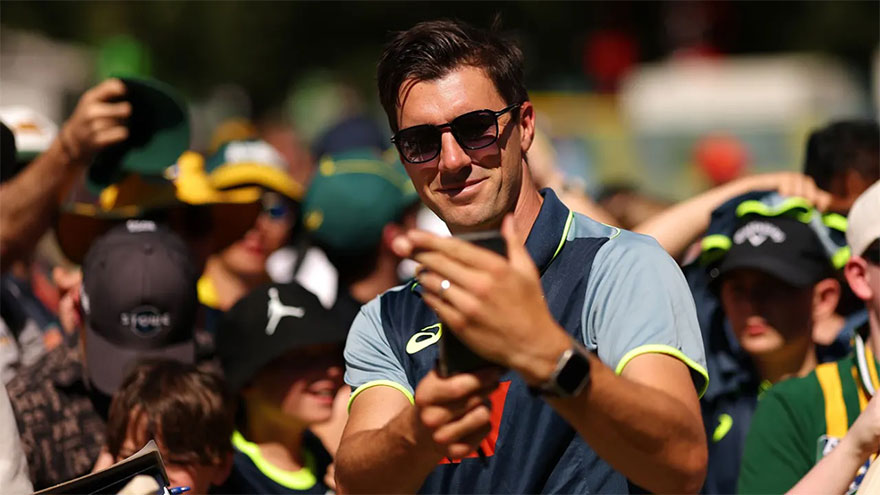
SYDNEY (Web Desk) - An Australia captain stating there is a "tension point" for players around forgoing the Hundred this August to play in two home Tests against Bangladesh is prescient and should set off alarm bells during Cricket Australia's BBL privatisation debate.
That Pat Cummins did so on the Business in Sport podcast, his second appearance in three years, is an irony that also should not be lost on anyone at Jolimont or among the states debating whether to allow private investment into the BBL.
"The interesting point is, obviously a big Ashes series, all the main guys want to play that series," Cummins said. "For example, during the Hundred this season we've got two Test matches against Bangladesh. All our guys that will play in that Test match have opted out of going to the Hundred auction but that's not going to be the case forever.
"Some of our guys are saying no to half-a-million pounds for 20 days' work to go and play those two Test matches against Bangladesh. I think it is a tension point. At the moment our guys are so keen to play for Australia that they're happy to forgo that, but I don't think we can accept that that is going to be the case forever."
Suggesting that players are forgoing £500,000, which equates to roughly AU$960,000, is not quite accurate. Tim David was the highest Australian male earner at the recent Hundred auction with a deal worth £350,000 (AU$673,000). Harry Brook is the Hundred's highest earner at £465,000 and only three players, all Englishmen, are earning over £400,000.
But the general point is worth delving into. Five Test players - Cummins, Josh Hazlewood, Mitchell Starc, Cameron Green and Travis Head - all currently earn significantly more than David in the IPL. There is no reason why those five couldn't earn a similar number in the Hundred auction based on their IPL market value.
The key difference is that David is a freelancer. He is not contracted to CA year-to-year, albeit he has consistently been upgraded to a central contract after qualifying through playing the minimum number of white-ball internationals (six). A CA upgraded contract is worth AU$353,574. Cummins revealed in the conversation that his national deal was worth close to AU$3 million.
"Yeah, roughly," Cummins said. "And that's a 10-month, basically a year contract. And that's quite a high Aussie contract. There's some that might be on less than a fifth of that, who are also locked into play for Australia for 10 months."
It's actually for 12 months. It's technically written into the Australian players' MOU that their rest period is April and May - the same period where Cummins and those other five forgo their rest to essentially double their income in the IPL. Cummins, and a number of those others, get rested from Australian duty at other times during the year as a result.
They are contracted to be available for the Tests against Bangladesh. They aren't playing for free. They are also paid a AU$16,318 squad fee per Test on top of their CA contract and $3,264 team fee if they play in the XI. There is also a $11,255 winning bonus for each individual player. Two wins against Bangladesh would net $61,674 on top of their contract, even if they are "forgoing" upwards of $670,000.
But it is clear from Cummins' remarks that the players are talking about it behind closed doors and they are doing the math on what freelance life looks like compared to playing for Australia.
"I'd say if you're playing all three formats in Australia you are very well compensated," Cummins said. "I'd say almost certainly if you played every other league you'd probably be better off in the short term. But our guys love playing Test cricket at the moment, but I don't think that's going to be the case forever. Someone else might have different priorities, so we've got to make sure that we adapt to that. We are starting to talk about longer-term deals to lock in the top tier talent to Aussies cricket."
They are already dealing with players who come and go. Marcus Stoinis was not selected for two T20I series against West Indies and South Africa last year when the T20 World Cup squad was being put together. As an uncontracted player he was allowed to go and earn over AU$400,000 in the Hundred.
He was then selected for series against New Zealand and India as well as the World Cup to qualify for the CA upgrade on top of what he earned in the Hundred. That was an opportunity not afforded to David, and two white-ball contracted players in Adam Zampa and Glenn Maxwell, whose CA deals are understood to be well less than a third of what Cummins earns.
"As Australian captain, something we speak about quite a bit is how do we make sure we've got our best Australian guys to choose from when we're picking a Test side or an ODI side," Cummins said. "Because there is so much demand for them elsewhere. I think even the way we contract players and talk about whether we let players go or not has evolved a lot in the last five or so years. Because we don't want to lose them. So you've got to give them a little bit more leash than maybe previously you did."
This is where the comments become prescient in relation to the BBL privatisation discussion. CA is hoping to make a decision in mid-April with the states now mulling over the proposal. But there are reservations about selling BBL clubs to private investors. There is an argument being presented that CA does not need to do it because the BBL is successful enough to withstand a handful of local and overseas players opting to earn far more money in the SA20.
However, Australia's players took particular note of Dewald Brevis earning AU$1.4 million last year when the top Australian earner in the BBL was making AU$300,000.
The current MOU runs until 2028 but is set to be renegotiated if the BBL privatisation goes ahead. In that context, Cummins outlining what his playing priorities are is illuminating.
"Definitely prioritise [certain] series but I'm still very keen to play all three formats," Cummins said. "At the moment I think we can make it work. I love Test cricket. We normally have about 10 Test matches in a year so that's what I kind of build my schedule around.
"IPL slots in there and there's normally one or two ICC events each year as well. That [the next ODI World Cup] is another very important white-ball tournament that I'm desperate to be a part of. So that kind of builds out most of the calendar. That's not going to move and then you kind of look to see what is going to slot in in between.
"Previously I've missed some ODI series because we've decided let's have two or three months in the gym to try and have a forced rest and get strong for a big Ashes series or whatever is ahead of that. I'm already prioritising. Hopefully I'm in a cadence where I can keep doing that for three, four, five years and don't have to forgo Test cricket."
Nowhere in there did he mention the BBL. He has not played in the tournament since 2019. None of Cummins, Hazlewood, Green or Head appeared in the most recent season. Cummins and Hazlewood were injured while the other two rested after the Ashes. Starc played five BBL games, his first appearances since 2014, but only because he had retired from T20I cricket. None of those five will play next season due to Australia's Test tour of India.
Cummins hasn't retired from T20I cricket, but he has not played since June 2024. He has played more games in Major League Cricket for San Francisco Unicorns (six) since then. He has also only played two ODIs in that time and has missed both ICC events: the 2025 Champions Trophy and the 2026 T20 World Cup.
But he has prioritised Test cricket and there is no question that he will attempt to play most if not all of Australia's 20 scheduled Tests in the next 18 months. It will be 21, if they reach the WTC final. One of those will be the 150th anniversary Test against England at the MCG in March 2027, which will be played in the weeks before the IPL and in the immediate aftermath of nine straight Tests against New Zealand and India.
That Test will be a celebration of the format with every living member of the teams from the 1977 Centenary Test invited to attend. That includes Greg Chappell, Dennis Lillee and a number of the Australian players who, it should be remembered, were secretly negotiating contracts with Kerry Packer's rebel World Series Cricket during that Test, which saw those players sit out of official Test cricket for two full years.
They would argue, quite fairly, that they took Packer's money to go from amateurs to professionals to continue to play the game rather than find another vocation.
The current players don't face that choice. But they are professionals in the business of sport. They will go where the money is. And if it is not in Australia, they may go elsewhere.