Summary The premier’s visit to Moscow will add a new chapter in bilateral relations as the ongoing military operation in Ukraine has changed the global politics
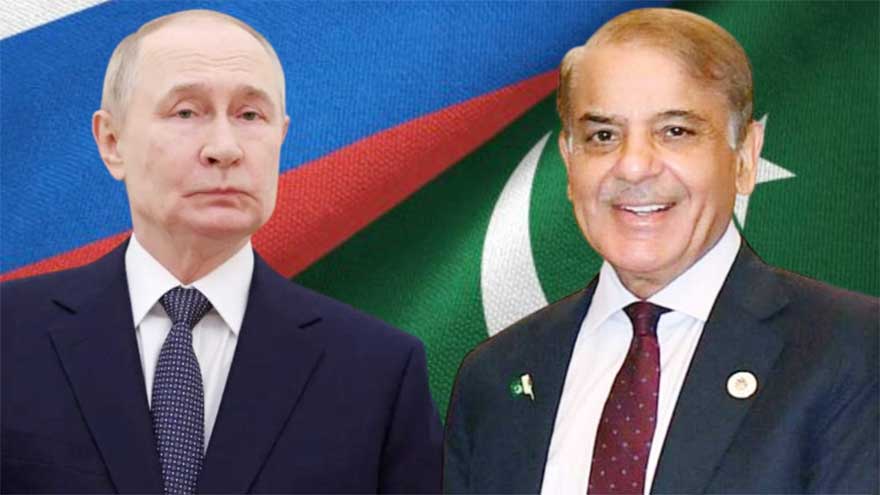
MOSCOW (Shahid Ghumman) – Prime Minister Shehbaz Sharif visit to Russia from March 2 to 5 will reflect Pakistan’s practical strategy in the changing global landscape.
The premier’s visit to Moscow is not merely a diplomatic engagement, it will add a new chapter in bilateral relations as the ongoing military operation in Ukraine has changed the global politics and raised new questions regarding energy, trade, and diplomatic balance. In such an environment, the growing engagement between Islamabad and Moscow has acquired extraordinary significance.
Reaching the corridors of the Kremlin in Moscow is not easy, and the meeting with Russian President Vladimir Putin will go far beyond a formal exchange of views. Behind it lie practical matters such as bilateral interests, energy needs, financial arrangements, and regional stability. Pakistan requires affordable energy and stable supply lines, while Russia is seeking new markets and partners.
The history of Pakistan-Russia relations has not been limited to diplomatic statements. The Pakistan Steel Mills, established in the 1970s with Soviet cooperation, was a symbol of industrial collaboration between the two countries. That project itself was proof that ties between Islamabad and Moscow could also be built on practical foundations.
Diplomatic circles are also discussing the possibility of progress on a memorandum of understanding or a new framework of cooperation regarding Pakistan Steel Mills. If that happens, it would not only revive a historic chapter but could also mark the beginning of industrial revival and a new era of bilateral economic partnership. However, the real significance will lie in ensuring that any potential agreement moves beyond paper declarations and translates into practical steps.
In this context, the Pakistan-Russia gas pipeline project is also noteworthy, as it could become another example of long-standing cooperation in the energy sector. If tangible progress is made on both these projects, the current visit could become more than just a diplomatic activity — it could lay the foundation for practical economic partnership.
An important aspect of the visit is the Pakistan-Russia Business Forum, in which 90 companies from Pakistan are participating. Alongside official negotiations, it will provide a platform for direct engagement with the private sector. Discussions are expected on cooperation in energy, agriculture, pharmaceuticals, IT, and textiles. If the business community is provided with a workable framework, this forum could become more than a ceremonial event and instead lay the groundwork for a real increase in bilateral trade.
The reality is that bilateral trade between Pakistan and Russia still remains below its true potential. The business forum is an effort to bridge that gap so that government-level agreements can be translated into private investment and practical projects.
An important yet less discussed aspect is the readmission agreement between Pakistan and Russia, which has not yet been finalised. Completion of this agreement could mark significant progress in legal and immigration cooperation and strengthen confidence-building between the two countries.
Similarly, visa policy remains a major practical issue. Obstacles faced by Pakistani businesspeople in obtaining business visas for Russia, as well as strict student visa regulations, are affecting the pace of trade and educational links. If the goals of the business forum are to be realised, visa facilitation must be prioritised. Diplomatic statements have their place, but without easing access for business and education, partnership cannot be fully achieved.
Pakistan’s foreign policy is no longer one-dimensional. Efforts are being made to advance balanced relations with Beijing, Washington, and Moscow alike. Rather than describing relations with the United States as “complicated,” it is more accurate to say that ties between the two countries are multidimensional and sensitive in nature. In this context, progress with Russia is part of Pakistan’s strategy of diplomatic balance — not the selection of any single bloc.
The Prime Minister’s meeting and iftar with Pakistani students residing in Moscow also reflects an element of soft diplomacy. Pakistani youth studying in Russian universities could serve as future diplomatic and commercial bridges, provided that facilitation is ensured at the policy level.
This visit is certainly full of possibilities, but the real test will be translating agreements into action. Energy, trade, the business forum, the readmission agreement, and visa policy — these are the points that will determine the true direction of Pakistan-Russia relations.
These meetings, taking place in the cold atmosphere of Moscow, could shape the course of the future. If practical progress is made in energy, industry, and trade, this visit could prove historic and give Pakistan-Russia relations a new dimension.