Summary “Today Pakistan is among the least developing countries in the region; the pace of development in the region is far ahead of Pakistan’s. We are burdened by debt and see no way out”
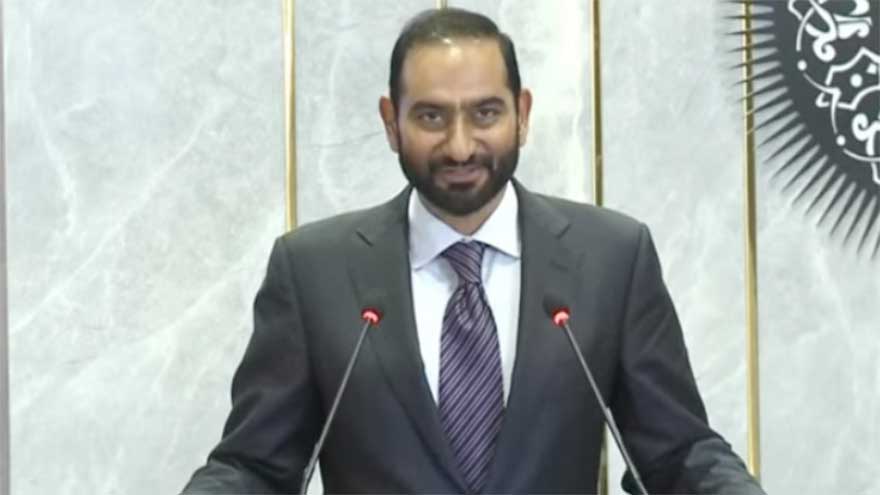
KARACHI (Dunya News) – Dunya Media Group Chairman Mian Amer Mahmood said on Thursday that there was a time when Pakistan was one of the fastest-developing countries in the region, but unfortunately, we were unable to maintain the momentum of this journey toward progress.
Addressing a seminar at Iqra University here, held under the nationwide awareness campaign of APSUP titled “Pakistan 2030: Challenges, Possibilities, and New Pathways,” he said that his association with Iqra University was very old.
Mian Amer said that Pakistan came into being 79 years ago.
“Today Pakistan is among the least developing countries in the region; the pace of development in the region is far ahead of Pakistan’s. We are burdened by debt and see no way out.”
He said that he did not wish to make any political statements, but perhaps their generation has failed the country the most.
He stated that what we needed was to educate our children. “Today 25 million children in Pakistan are out of school. There is no other country in the world where so many children are not attending school, and surprisingly, the number of out-of-school children continues to rise every year,” he added.
Pakistan is a federation. But we are the only federation in the world where one federating unit is larger than the other three combined. Punjab alone constitutes 52% of Pakistan. We have made our provinces extremely lopsided, Mian Amer continued.
He said that one province is larger in population than the other three combined, while Balochistan comprises half of Pakistan’s land area but has a population smaller than that of Karachi. Balochistan is so vast that the government cannot control it from Quetta. We have divided Balochistan into A and B areas to this day — an indication that we have never been able to properly administer such a large region.
He said that any country or state has seven fundamental responsibilities toward its citizens. If a country works for public welfare, the people will consider it their own and love it. These responsibilities include public welfare, law and order, a system of justice, economic welfare, political welfare, and ensuring the protection of national borders.
He explained that a state exists so that if another country attacks, it can defend its borders. He cited a World Bank report published in March 2019, which assessed what Pakistan might look like after 100 years. The report stated that regional inequality must be addressed for development to occur.
Mian Amer said that institutions in Pakistan have become weak. These institutions lead to increased corruption: people gain power while institutions weaken. If institutions remain weak, the system falls into the hands of the powerful, and corruption persists, preventing the country from developing. He added that power and funds have never been extended to the common people.
He emphasized that until local governments are strong, development remains a dream. Pakistan is the fifth most populous country in the world. Among large countries, China and India are the top two. China has 31 provinces. At the time of independence, India had nine provinces; today it has 39. India creates new states every five to ten years, and each newly created state tends to develop faster than the older ones.
He also noted that Pakistan does not calculate the GDP of its provinces separately, nor does it track which province has contributed what. According to the 1951 census, Pakistan’s population was 33 million, with only 6 million in the entire Sindh province. Today, a single neighborhood in Karachi may have that many people. He concluded that if the country had focused on people’s welfare from the beginning, Pakistan might not have faced the current challenges.
Mian Amer said that Iran has more provinces than Pakistan, and local governments there are stronger than the provinces. He noted that only 12 countries in the world are larger than Punjab, 31 countries are larger than Sindh, and 41 countries are larger than Khyber Pakhtunkhwa. Most of Pakistan’s provinces are larger than the majority of countries worldwide.
He added that even the largest countries in the world are smaller than some of Pakistan’s provinces. Balochistan alone is larger than 172 countries. He criticised the current lopsided provincial setup and emphasized that the focus should be on what these provinces have done for their citizens.
He suggested that every division in Pakistan should be made a province. He recalled that local governments were established but later abolished, noting that the first action after democracy was restored in Pakistan was to dissolve local governments. According to him, Punjab’s 10 divisions could be turned into 10 new provinces.
He addressed concerns about creating new provinces in Sindh, highlighting that Sindh and Khyber Pakhtunkhwa have very old historical traditions. He noted that Khyber Pakhtunkhwa historically conquered much of India, and areas like Peshawar and Qalat were historically significant regions, with disputes arising since their inclusion in Pakistan.
He stated that when political parties talk about ethnicity, they are often covering up their failures. Ethnic divisions are promoted to win votes, which does not benefit the public. Sindh currently has seven divisions; new divisions and districts can be created, and administrative boundaries can be reorganized to form new provinces. He stressed that nothing prevents this from happening.
He said that if divisions in Sindh were upgraded to provinces, Karachi could become a province. He highlighted Karachi’s potential, claiming that with good governance, it could surpass Dubai in business, industry, population, and trade. Karachi as a province would have a population of 20-25 million.
He proposed that Khyber Pakhtunkhwa’s seven divisions become seven provinces and Balochistan’s eight divisions become eight provinces, making a total of 33 provinces. He argued that frequent discussions about 33 provinces are necessary for national development.
He cited UN Sustainable Development Goals, stating that in a survey of 167 countries, Pakistan ranked 140th. Sudan, Tanzania, and Syria ranked lower due to wars. In the Human Development Index of 193 countries, Pakistan is 168th. Regarding the rule of law, Pakistan ranks 129th among 142 surveyed countries.
He highlighted that 44% of Pakistani children are experiencing stunted growth, which affects both their physical and cognitive development. The 25 million children who are out of school today may become a burden on national development in 10–15 years.
He argued that if reforms are not implemented now, the future of the country will be compromised. Critics often say that new provinces will increase expenses, but he claimed the opposite: creating new provinces would reduce costs.
In new provinces, the overhead for the chief minister and administrative staff would decrease. Currently, Punjab has a population of 130 million and Sindh 60 million under their respective chief ministers. In smaller provinces, personal expenditures on fleets, planes, and staff would be minimized, reducing overall expenses.
Earlier, APSUP Chairman Chaudhry Abdul Rehman said that it has been 79 years since Pakistan’s creation, and we must assess the direction in which we are heading. If the direction is right, the journey ultimately reaches its destination. Our people want to become rich overnight, he noted, adding that a role model is needed to develop good character.
He said that over 95% of Pakistan’s population is Muslim, and we must work on building our character.
He said Mian Amer has given the nation 450 educational institutions where more than 500,000 students are enrolled. He has given the country four universities. He emphasized that Pakistan needs to fix its governance model and must reduce the size of its administrative units so that resources can be transferred more effectively to lower levels.