Summary Mian Amer Mahmood emphasised decentralisation, urging creation of smaller provinces and stronger local governments for efficient governance and better public service.
ABBOTTABAD (Dunya News) – Dunya Media Group Chairman Mian Amer Mahmood has said that it is impossible for the federal government sitting in Islamabad to effectively serve 250 million people, adding that creating smaller provinces would make problem-solving easier.
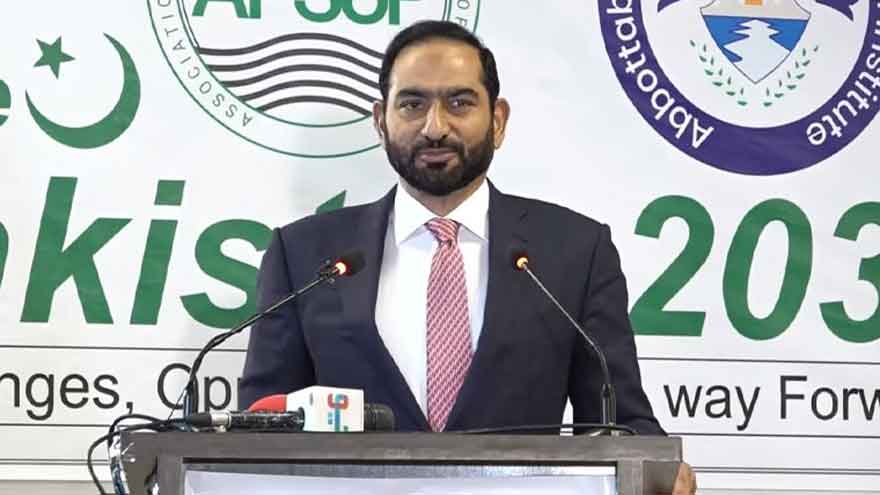
Speaking at a seminar titled “Pakistan 2030: Challenges, Opportunities, and New Pathways” organized by the Association of Private Sector Universities of Pakistan (APSUP) at Abbottabad International Medical College, he said that in other major countries, the federation is divided into several administrative units for efficient governance.
Mian Amer Mahmood noted that all major countries reduced the size of their administrative units over time to better serve their people. Pakistan, the fifth most populous country in the world, still has only four provinces and has never restructured them.
He said that looking at Pakistan’s four provinces, one can see no proper administrative balance. He recalled that the 2001 Local Government Ordinance was considered an excellent system in Pakistan’s governance history.
He added that under that system, the mayor served as the executive head of the district, but it lasted only eight years. Once political governments and provincial assemblies came into power, they abolished the local government system. He emphasised that the true service to the people lies in local governance — one of the three pillars of the state alongside the federation and provinces.
Mian Amer Mahmood lamented that the local government in Pakistan has never been allowed to stabilise. Despite repeated efforts, it has failed to sustain. He said that the federal government is a combination of federating units, and Pakistan’s four provinces together form the federation — a model followed by most countries around the world.
Mian Amer Mahmood said that Punjab makes up 52% of Pakistan’s population, and there is no example in the world where a single federating unit is larger than all others combined. He added that 172 countries are smaller in area than Balochistan — Pakistan’s largest province by land but smallest by population — and it is impossible to establish full government control over such a vast region from Quetta alone.
He pointed out that China, with a population of 1.5 billion, has 31 provinces; the United States began with 17 and now has 50; Indonesia, with 270 million people, has 34 provinces; Nigeria, the sixth most populous country, has 27; Brazil, with 200 million people, has 36; and Mexico, with 130 million, has 31 provinces. In contrast, Pakistan, with nearly 250 million people, has only four provinces.
Mian Amer Mahmood said that every government has seven core responsibilities after coming into existence, including ensuring the economic welfare of its people and formulating policies that promote financial growth, while border security remains a federal duty.
He mentioned that the World Bank once conducted a study on Pakistan’s future and published a report on how the country would look at 100 years of independence. The report highlighted uneven regional development — in 79 years, Pakistan has developed only five capital cities. “If Punjab were a country, it would be the 13th largest in the world,” he said.
He noted that in Khyber Pakhtunkhwa, development is centered around Peshawar, and even Peshawar’s condition is not ideal.
Similarly, outside Lahore, Punjab’s development is limited, though recent initiatives have begun beyond the city. In Sindh, areas outside Karachi resemble underdeveloped settlements.
He added that overdeveloping one city leads to overpopulation and strain due to migration. Lahore’s population continues to grow rapidly each year.
Mian Amer Mahmood recalled that Pakistan’s first census in 1951 recorded a population of 33 million, while today it stands close to 250 million. Punjab now has around 130 million people; Sindh started with 6 million, but Karachi alone has over 30 million today.
Mian Amer Mahmood said, “We are here today in a region that has long been demanding provincial status. Its people have made great sacrifices for their own province. We join your cause and call for making every division in Pakistan a province. Smaller provinces will ensure equal development across the country.”
Society cannot change without transformation: Chaudhry Abdul Rehman
Earlier, APSUP Chairman Chaudhry Abdul Rehman said that today will be remembered in Abbottabad’s history. Pakistan is nearing 80 years of independence and will complete 100 years in two decades — we must think about where our country will stand then.
He said that Pakistan is a Muslim country with 95% Muslim population, yet ranks 135th in global transparency. He praised Mian Amer Mahmood as a true Pakistani and a great leader who is enlightening over 650,000 students every year.
He added that Mian Amer Mahmood has gifted Pakistan over 450 colleges and 4 universities. “Our purpose here is to improve our future. Unless we change individually, our society cannot change. We must become good humans before becoming doctors or engineers.”
Chaudhry Abdul Rehman further said that Mian Amer Mahmood has served the nation by spreading education and successfully serving as a city administrator. “We must improve our governance model; the entire nation now demands better governance and devolution of powers to the grassroots level.”