


Punjab cities choke as toxic smog blankets Lahore, DG Khan and Kasur
Pakistan
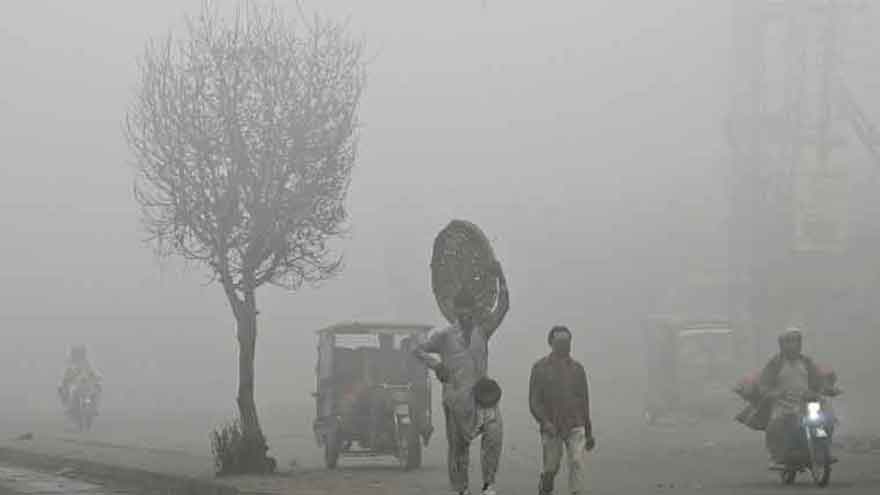
Punjab’s major cities were shrouded in dense smog on Saturday as AQI levels soared beyond hazardous limits, with Dera Ghazi Khan and Kasur recording world-high pollution.

LAHORE (Web Desk) - Punjab’s leading cities remained enveloped in a thick blanket of smog on Saturday morning, as air quality plunged to hazardous levels across the province.
According to data from the International Environmental Monitoring Agency IQAir, the Air Quality Index (AQI) reached the maximum value of 500 in Dera Ghazi Khan and Kasur at 9am, placing both cities among the most polluted in the world. These figures even surpassed Lahore, long considered the country’s pollution hotspot.
IQAir Punjab reported that Lahore recorded an AQI of 385, Sheikhupura 313, and Gujranwala 243 during the morning hours. Later in the day, IQAir’s global feed showed even higher readings – 442 in Gujranwala, 400 in Lahore, and 337 in Faisalabad.
Within Lahore, pollution levels varied sharply by area. IQAir data showed extreme concentrations, reaching 1018 AQI near the Civil Secretariat, 997 near Wildlife Parks, and 820 around the Forest Department. Official figures from the Environment Protection Department (EPD) also confirmed alarming levels — 500 along Shahdara, Multan Road, and GT Road, and above 350 in several other zones.
Environmental experts attributed the deteriorating air quality to polluted easterly winds from across the Indian border, falling temperatures, low wind speeds (1–4 km/h), and lack of rainfall, which have trapped pollutants close to the ground. The EPD said slight improvement might occur later in the afternoon as wind speeds pick up.
Maryam Shah, environmental expert and member of the Pakistan Air Quality Initiative, noted that while air quality was relatively cleaner earlier in 2025, PM2.5 concentrations in October matched last year’s high levels, warning that “November – typically the peak smog month – could bring another severe episode.”
Under directives from Chief Minister Maryam Nawaz, the Punjab government has launched a province-wide anti-smog operation, involving traffic regulation, road sprinkling, and industrial emission inspections. Continuous monitoring of PM2.5 and PM10 is being conducted through modern air quality stations.
Environmentalists warn that without sustained enforcement and regional cooperation, Punjab’s residents will continue to breathe dangerously polluted air through the coming months.
