


Devolution of power only guarantor of development: Mian Amer Mahmood
Pakistan
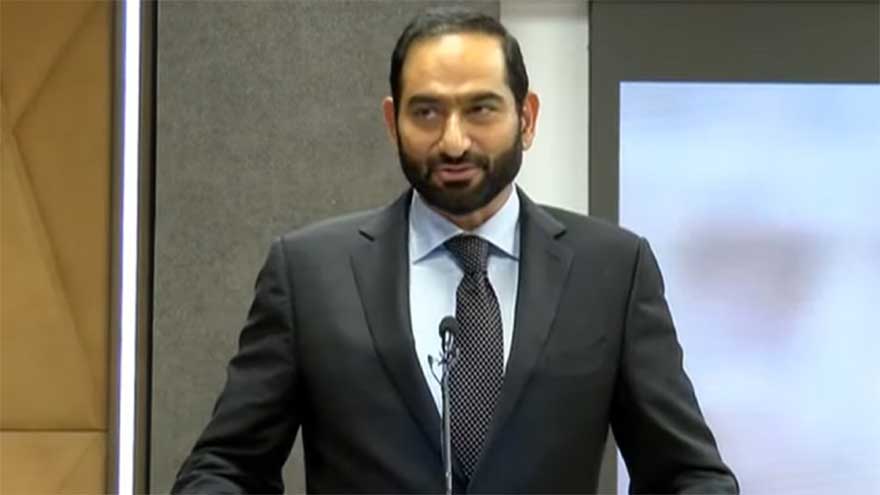
Mian Amer was speaking at the University of Southern Punjab here regarding creation of province

MULTAN (Dunya News) – Dunya Media Group Chairman Mian Amer Mahmood has said there will be no development intil powers are devolved to the grassroots level.
Addressing a seminar organised by APSSP “Pakistan 2030: Challenges, Opportunities, and New Directions", he said that Pakistan currently has four provinces, and Punjab makes up 51% of the country.
He said our population is massive, and the government does not have control over it
He said that at the time of Pakistan's creation, the population of Balochistan was only 1.1 million.
Mian Amer said that Punjab is larger than the other three provinces combined. It has a population of 130 million, and if Punjab were a separate country, it would be the 13th largest in the world. Similarly, if Sindh were a country, it would be the 32nd largest in the world, he added.
He said that the World Bank published a report in 2019, which explored what Pakistan would look like when it turns 100 years old. It is often said that Southern Punjab has not seen development because it is far from provincial capital Lahore, and this is absolutely true.
The Dunya Media Group chairman said that Pakistan has so far developed only five capital cities. In Punjab, for the first time, 43 modern air quality monitoring devices and stations equipped with advanced technology have been installed.
“Had welfare work been done in Balochistan, the province wouldn't be facing the conditions it is today,” he added.
Mian Amer stated that Pakistan's current population is 250 million. Balochistan's population is now around 15 million, while Punjab started with a population of 20 million and now has nearly 130 million. The population of Sindh today is around 55 million.
He stated that in the past 80 years, many leaders and political parties have come into power, and “we cannot say that all leaders were bad.” He suggested, “We are proposing that every division of Pakistan should be made into a province. Doing this would result in a total of 33 provinces.”
The chairman quoted examples of various countries; Mexico has a population of 130 million and 31 provinces, China has 31 provinces, India, which gained independence alongside Pakistan, now has 39 provinces, having created 30 new ones in the past 80 years, Brazil has a population of 220 million and 36 provinces.
Pakistan still has only four provinces since its creation, he continued.
Mian Amer said that the country’s faced decline in every field and our economic conditions worsened. The dollar continued to rise at its own pace, and the value of the rupee kept on falling. Various types of governments had come and gone, including martial law, and even though “we lost half the country, our condition has remained the same.”
He stated that everyone shares equal responsibility for the country’s present situation. If smaller provinces are created, at least some leaders will emerge who perform well within their own province. Those who advance based on merit will also be capable of delivering on the national level.
He said that today, all leaders emerge through the same process. When a leader looks toward the public in difficult times, the public is no longer there to support them. No one has brought real change to our lives.
He gave the example of the president of Turkey, who first proved himself in local government before rising to national level. “Our leaders have not come through any such process,” he added.
He gave the example of India where system allowed a tea seller to become the prime minister. Across the world, political leadership often emerges from the middle class.
He cited the example of Arshad Nadeem, Pakistan’s javelin thrower who became an Olympic champion. "Everyone wanted to take credit for his victory, but Arshad first defeated the system, and then won the medal."
He lamented that due to these oversized administrative units, 44% of children in Pakistan suffer from stunted growth.
“The number of children with stunted growth is increasing,” he said and added "there are 25 million children out of school in Pakistan today. These children won’t be able to work themselves, nor will they let others work productively.”
Mian Amer stressed on making every division a province. Some divisions, he pointed out, are older than many of the current provinces.
He proposed to make the Commissioner the Chief Secretary, and make the RPO the Inspector General (IG) of police.
He criticised political parties for promising new provinces to get votes and then forgetting those promises after elections.
He said that in India, administrative units were divided so leadership could be brought closer to the people. “Here, for every major issue, people have to go to Lahore. Currently, 50,000 schools in Punjab are being run from Lahore, and as a result, 25 million children are out of school. Tomorrow, these uneducated children will become unemployed adults.”
The Dunya Media Group chairman said that when institutions are weak, corruption increases. Strengthening institutions will reduce corruption.
He said that the government files cases against the corrupts and sends them to court, but a single Supreme Court judge has about 4,000 cases, and a Lahore High Court judge has around 3,000 cases. How many cases can they hear?
Mian Amer said that murder cases trial takes 16 to 18 years, during which both families are destroyed. If every division becomes a province, courts will be established there and the case burden will reduce.
He stressed that devolution of powers to lower levels is essential for progress. Cosmetic changes won’t help; you must create smaller provinces. Service delivery comes from provinces, but the current provinces are too large to function effectively.
The chairman said that the people are the real stakeholders and they are the ones suffering. “We speak for the benefit of the public.”
He added, if divisions continue to be run as they are, no change will be needed. The chief minister sitting in Lahore has to look after every city. But if Multan becomes a province, its priority will be one division only. Smaller provinces will enable faster decision-making, development, and problem-solving.
Mian Amer said that there have been multiple attempts to create local governments in 80 years, and one was even formed during martial law. Our leaders have no fear of accountability from the public. The people should decide to vote only if their demands are met; otherwise, they should withhold votes.
He said “we are here to propose a solution and raise awareness among the public. We have come to the youth and students because 64% of our population is youth.”
He clarified: “I am not making an emotional statement or political slogan. I have 80 years of data. Political parties, government, and parliament must do this work. First, we all must unite in demanding this.”
Mian Amer said that a common factor in all problems is the government’s irresponsible attitude. Every province has different issues, and the government addresses whatever issue it chooses. Education is the biggest problem, but the government simply doesn’t have enough time.
He said “if there is a procession or strike, it drags on for days. We have concluded that smaller provinces will give the government more time to focus. Problems vary in nature, but with smaller provinces, the government will be better able to solve them.”
‘LEADERSHIP CRISIS’
Earlier, Chairman of APSSP, Professor Dr. Chaudhry Abdul Rehman, stated that today will be a historic day for the entire Multan region. He said that a leadership crisis exists all over the world. The Holy Prophet Muhammad (PBUH) brought about change with limited resources — a change that no one else could bring.
Chaudhry Abdul Rehman further said that the Holy Prophet (PBUH) transformed society based on his own noble characteristics. We have a model of leadership that even the West does not possess. The Prophet (PBUH) delivered the message of Allah to the people. He was known as truthful and trustworthy (Sadiq and Ameen).
He said, “I consider Mian Amer Mehmood a benefactor of the nation. He has given this country 400 colleges and three beautiful universities. Mian Amer Mehmood has played a significant role in the education sector.”
The APSSP Chairman also said that Multan, Dera Ghazi Khan, and Bahawalpur should become a separate province. The fate of South Punjab can be changed, and the leadership crisis will be resolved by the formation of smaller provinces.
